

Time and attendance solutions are critical tools for businesses to manage employee work hours efficiently. By automating the tracking process, these systems ensure accuracy in payroll, compliance with labor laws, and increased productivity.
This article explores everything you need to know about time and attendance solutions, from types and features to implementation tips and future trends.
Time and attendance solutions refer to systems, either manual or automated, used by companies to record the working hours of their employees. Automated systems have grown in popularity as they reduce errors and improve efficiency compared to traditional methods like manual punch cards.
Table of Contents
- Manual vs. Automated Solutions
- Key Features of Time and Attendance Systems
- Types of Time and Attendance Systems
- Benefits of Implementing Time and Attendance Solutions
- Challenges in Time and Attendance Management
- How Time and Attendance Solutions Improve Productivity
- FingerTec TA500 Fingerprint Time Clock
- CS Time Clock Proximity Model
- Choosing the Right Time and Attendance Solution
- Future Trends in Time and Attendance Technology
- FAQs
- Conclusion
Manual vs. Automated Solutions
While manual systems rely on physical or paper-based methods, automated solutions streamline time tracking, using software or biometric technology for higher accuracy and security.
Key Features of Time and Attendance Systems
Employee Clock-In and Clock-Out
The ability to log employee work hours is at the core of any time and attendance system. This includes start times, break periods, and end times. Accurate timekeeping helps to ensure that employees are being compensated fairly and are following company policies. Digital systems often offer time stamps, eliminating the need for manual punch cards and reducing errors.
Biometric Verification
Biometric time clocks use unique identifiers like fingerprints, facial recognition, or even iris scanning to verify an employee’s identity. This method prevents “buddy punching,” where one employee clocks in for another. Biometric verification is highly secure and ensures that only the person assigned to the shift can log time.
Integration with Payroll Systems
One of the most significant benefits of automated time and attendance management software is seamless integration with payroll software. This integration minimizes manual data entry errors, ensures that overtime and leave are calculated correctly, and can automatically apply different pay rates based on hours worked. The direct link between timekeeping and payroll saves administrative time and reduces payroll errors.
Mobile Accessibility
Modern systems provide mobile access through apps, allowing employees to clock in and out from their smartphones. This feature is particularly valuable for remote or field based workers, enabling them to log time from different locations. Mobile apps also often include features like GPS tracking, ensuring that employees are logging in from authorized locations.
Types of Time and Attendance Systems
Biometric Time Clocks
Biometric time clocks enhance security and accuracy by using physical traits, such as fingerprints or facial recognition, to track attendance. These systems ensure that only authorized employees can log their time and are particularly effective in environments where security is paramount.
Proximity Card Systems
Proximity card systems use RFID (Radio Frequency Identification) cards or badges. Employees simply swipe or tap their card near the reader to clock in and out. While not as secure as biometric systems, proximity cards are still automated and prevent manual errors. These are commonly used in environments where speed and ease of use are prioritized.
Web-Based Time Tracking
Web-based systems enable employees to log their hours from any internet-connected device. These systems are ideal for remote workers or companies with flexible work environments. Employees can use a web browser to clock in and out, and the data is stored in the cloud, making it accessible to HR teams in real time.
App-Based Systems
Many time and attendance systems offer mobile apps, allowing employees to clock in and out using their smartphones. These apps are especially useful for employees working in the field, as they often include GPS location tracking to ensure the employee is clocking in from an approved location. This type of system offers flexibility and real-time updates.
Comprehensive Guide to Time and Attendance Management Software
Maximize Efficiency with Time and Attendance Management Software
Benefits of Implementing Time and Attendance Solutions
Accuracy in Time Tracking
Automated systems reduce the potential for human error in time tracking, ensuring that employees’ work hours are recorded correctly. This accuracy is crucial for both payroll processing and compliance with labor laws.
Reduction in Payroll Errors
When time and attendance are integrated with payroll software, manual data entry is eliminated, reducing the likelihood of payroll errors. This saves both time and money for the organization and ensures that employees are paid correctly.
Compliance with Labor Laws
Time and attendance systems help businesses comply with labor regulations, such as overtime, minimum wage laws, and mandated breaks. The system can automatically track when employees are entitled to overtime or ensure that employees are taking legally required breaks.
Enhanced Employee Accountability
With real-time tracking and verification features, these systems increase employee accountability. Since there is less opportunity for time theft (e.g., buddy punching), businesses see an improvement in employee attendance and punctuality.
Challenges in Time and Attendance Management
Handling Remote Employees
Managing attendance for remote or field employees can be difficult without the right system in place. Mobile or web-based time tracking systems are essential for accurately recording the hours of employees who work outside the office. However, some companies struggle with finding the right solution that meets both their needs and those of their employees.
Data Privacy and Security
With the use of biometric systems and digital data collection, companies must ensure the security and privacy of employee data. This includes complying with data protection laws such as GDPR or CCPA, securing data against breaches, and ensuring that biometric data is not misused.
Integration with Existing Systems
Not all companies have existing payroll or HR systems that can seamlessly integrate with modern time and attendance solutions. This can create additional administrative burdens or result in incomplete data sharing between systems. Businesses may need to invest time and resources to ensure proper integration or choose a solution that works well with their existing infrastructure.
How Time and Attendance Solutions Improve Productivity
By automating time tracking, companies eliminate the need for manual entry, reducing errors and freeing up HR teams to focus on other tasks. Additionally, real-time data insights provide managers with valuable information to optimize workforce efficiency.
FingerTec TA500 Fingerprint Time Clock

The FingerTec TA500 Fingerprint Time Clock is a user-friendly and cost-effective biometric time clock designed to enhance employee attendance tracking with precision. It utilizes advanced fingerprint technology, ensuring accurate and reliable identification, eliminating buddy punching, and minimizing time theft.
Key features include:
- Biometric Authentication: Supports fingerprint verification for secure and accurate attendance recording.
- Large User Capacity: Stores up to 2,000 fingerprint templates and 80,000 transaction logs, ideal for small to medium businesses.
- Quick Fingerprint Recognition: High-speed recognition ensures efficient clock-in/out for employees.
- Standalone Operation: Works independently without the need for a computer, making it highly convenient.
- Easy Data Management: Equipped with USB connectivity for data transfer, simplifying record export and payroll processing.
CS Time Clock Proximity Model
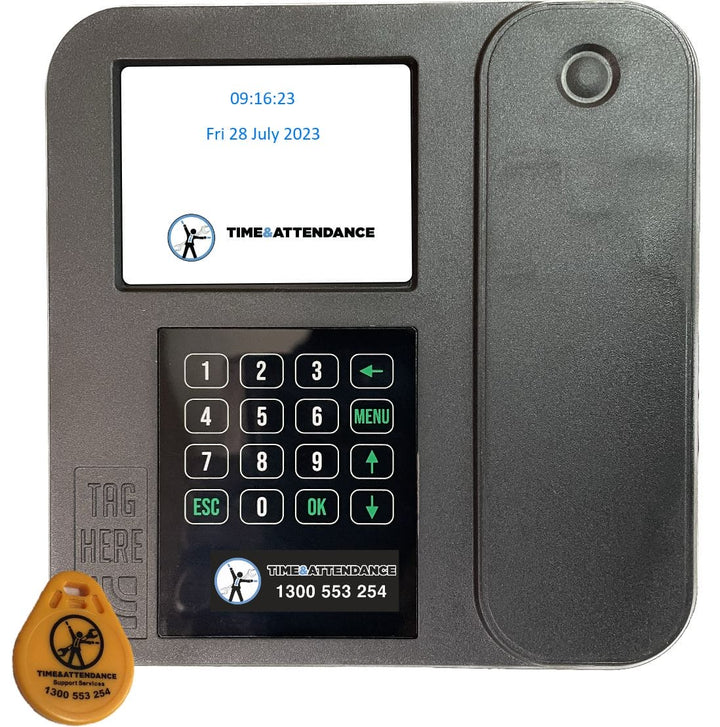
The CS Time Clock Proximity Model is an efficient and reliable time-tracking device designed to simplify employee attendance management. Using advanced proximity card technology, this time clock ensures quick and contactless clock-in/out, reducing wear and tear while enhancing workplace efficiency.
Key features include:
- Proximity Card Reader: Allows fast and secure clocking using proximity cards or key fobs, eliminating the need for manual entry or fingerprints.
- High Capacity: Supports a large number of users, making it suitable for businesses of all sizes.
- Standalone Operation: Operates independently without the need for continuous computer connectivity, providing flexibility for various work environments.
- User-Friendly Interface: Intuitive and easy to use, minimizing the learning curve for employees and administrators.
- Data Export Options: Supports USB data transfer for convenient export of attendance logs, simplifying payroll processing and reporting.
Choosing the Right Time and Attendance Solution
Company Size and Needs
Different solutions cater to businesses of various sizes. Small businesses may prefer cloud-based systems, while larger enterprises may need more customizable, on-premise solutions.
Customization Options
Choose a system that offers flexibility in terms of features, especially as your company grows.
Budget Considerations
While more advanced systems come with higher costs, the long-term savings through efficiency and accuracy often justify the investment.
Biometric Time and Attendance Systems
Biometric systems, such as fingerprint and facial recognition, offer enhanced security by ensuring that only the authorized employee can clock in. However, concerns about data privacy must be addressed when implementing these technologies.
Integration with Payroll and HR Systems
Time and attendance solutions that integrate seamlessly with payroll and HR systems streamline processes, reducing administrative work and ensuring compliance with laws regarding work hours, overtime, and leave management.
Time and Attendance Solutions for Small Businesses
Small businesses benefit from cost-effective, cloud-based solutions that offer flexibility and scalability. These systems are easy to implement and do not require extensive IT resources.
Time and Attendance Solutions for Large Enterprises
Large enterprises with complex workforce structures require more sophisticated systems that can handle shift scheduling, multiple locations, and in-depth reporting. These systems offer detailed analytics to help companies manage their workforce more effectively.
Future Trends in Time and Attendance Technology
Artificial intelligence, geofencing, and wearable technology are shaping the future of time and attendance solutions. These advancements offer even greater accuracy and flexibility for businesses to monitor employee work hours.
FAQs
What Are the Costs Involved?
Costs vary depending on the complexity of the system. Small businesses can expect to pay less for cloud-based solutions, while large enterprises may need to invest more in on-premise solutions.
Are Biometric Systems Safe?
Yes, biometric systems are generally safe, but businesses must ensure data privacy regulations are followed.
Can Time and Attendance Systems Integrate with Other Software?
Yes, many systems offer integration with payroll, HR, and other business software to streamline processes.
Conclusion
Time and attendance solutions are essential for modern workforce management, offering accuracy, compliance, and increased productivity. Businesses can enhance their operational efficiency by selecting the right system and implementing it carefully.


 0
 0